VERONIKA SLACHTOVA
 Copenhagen, DK / Remote
Strategic Product Designer
— I design digital products and systems that scale.
Copenhagen, DK / Remote
By combining a structured design process, AI workflows, and close collaboration with users and cross-functional teams, I help businesses turn complex challenges into useful solutions. With 10+ years of experience across startups and mature organizations, I lead product design from strategy to delivery.
Projects
AI agent handling 54% of Airbnb reservations
Lead Product Designer · 2024–2026 · Started as a team of three, ended up as one of product's main selling point.
Lean process
Agentic design
Stakeholder workshop
Conversational AI & Ethics
Show more
How I work
 Design strategy
 Systematic delivery
Design strategy
•Design Ops (project/process planning)
•Methodology (OOUX, Design thinking, Goal directed)
•Scope and stakeholder management
•Product and Brand strategy
•Design team leadership
Product design
•Research, User interviews, Audits
•Problem definition and exploration
•Prototyping with AI
•Building atomic system
•UI, UX, Agentic design
•Web & Mobile applications
•Complex redesign projects
Systematic delivery
•Design systems
•From research to testing
•Design documentation and Handoff to developers
•Claude design prototyping
•Judgment, taste and skill to direct AI
•Lean, Agile, and AI-supported
TOOLS
Other projects
collaborations
articles written by veronika slachtova
{{ article.title }}
Contents
{{ item.title }}
AI agent handling 54% of Airbnb reservations
Lead Product Designer · 2024–2026
Lean process
AI agent
Stakeholder workshop
Conversational AI & Ethics
Summary
Maia is an AI agent built into RentalReady, a SaaS for professional property managers operating in the short-term rental and hospitality industry. This project shows how I lead design in a lean product environment: moving quickly from concept to release, working closely with engineers, and collaborating directly with stakeholders and users to guide continuous improvement.
Guest communication at scale is expensive and it doesn't follow office hours. In Q2 2026 alone, guests opened 261,496 conversations with 2.47 million messages, and the same topics keep repeating: door access, missing payments, missing check-in instructions.
AI agent Maia handles guest conversations, creates maintenance tickets, runs quality audits and sells late check-ins. It cuts down the handoff friction between Support, Operations and Finance, minimising context switch and high volumes of repetitive requests. It also handles troubleshooting when a guest is stuck in front of their door at midnight.
I led design on this project from the pilot in early 2024, starting as a team of three with one engineer and the CTO. Designing an agentic interface in 2024 was a new design challenge, with immature technology, a short deadline, and few established patterns to borrow from. The core design problem was how much control to give users over an agent that acts in their name and talks directly to their guests. Users can configure one or more agents, each with its own tone of voice, scope and instructions, and audit everything the agent has done. To catch failures early, we built reporting into the inbox, a Slack alert on every report, and an audit page visible to both us and the customer.
Four months after launch, I planned and facilitated two AI strategy workshops with stakeholders across the business, including the CEO, CTO, Product Director, and others. I processed the output into six opportunity areas and shared them with the stakeholders shaping the product roadmap. By summer 2026, five of the six had shipped, including Maia's ticket creation from conversations, which today auto-flags around 92% of all tickets in the system.
The project proved its impact in Q2 2026, when Maia's coverage increased from 38% to 54% of reservations in a single quarter, while the guest communication rating increased from 4.58* to 4.71* out of 5*.
Today, Maia is one of RentalReady's main selling points, enabled on 5,781 properties at a flat rate of €5 per property per month, generating around €350,000 in 2026.The difference between a useless chatbot and a reliable AI agent is massive. The project led me to create a set of ethical design principles for AI, now established within our product team, and to publish an article on designing conversational AI that builds trust. The position I argued for, disclosing to guests when they are talking to AI, became a legal requirement in the EU in August 2026. Ethical AI is not a one-time audit: new models are introduced, regulations change, users adapt, and new needs emerge, which is why monitoring and continuous improvement are essential when designing AI products.
of reservations covered by agent Maia
guest communication rating, out of 5*
human response time
The project proved its impact in Q2 2026, when Maia's coverage increased from 38% to 54% of reservations in a single quarter, while the guest communication rating increased from 4.58* to 4.71* out of 5*.
Today, Maia is one of RentalReady's main selling points, enabled on 5,781 properties at a flat rate of €5 per property per month, generating around €350,000 in 2026.The difference between a useless chatbot and a reliable AI agent is massive. The project led me to create a set of ethical design principles for AI, now established within our product team, and to publish an article on designing conversational AI that builds trust. The position I argued for, disclosing to guests when they are talking to AI, became a legal requirement in the EU in August 2026. Ethical AI is not a one-time audit: new models are introduced, regulations change, users adapt, and new needs emerge, which is why monitoring and continuous improvement are essential when designing AI products.
Q1
38%
Q2
54%
Q1
4.58*
Q2
4.71*
Q1
22 min
Q2
12 min
5,781
properties, 49% of the platform
×
€5
per property, per month
=
≈ €350,000
generating in 2026
The problem of scale
RentalReady is SaaS for customers running short-term rental businesses at scale, across Europe, Dubai and Brazil. An average customer manages 20-100 properties, with exception of handful companies with portfolio of 200-800 homes. Then there is the Enterprise customer with 3800 properties.
Guest communication at scale is expensive, requires troubleshooting and it doesn't follow office hours. Customers require separate teams for guest support available 24/7. Responding and prioritising messages takes time, the support team needs to constantly switch context and work daily with angry guests. In Q2 2026, guests opened 261,496 conversations. A property manager with 200 properties is dealing with hundreds of separate threads a day, in several languages, across 7+ booking channels. Guests often reach out at midnight about a problematic check-in, ask for a restaurant recommendation, or question why the wifi does not work. We can see the pattern that 76% of guest contact happens before the stay or at arrival, and the topics
When an issue does need a person, it rarely needs only one. A reservation thread can travel from Guest Support to Operations, and further to Finance if a Airbnb claim or reimbursement needs to be settled. Every handoff is a place where context is lost and time passes.
Only part of this really needs a person, especially if all the important data about property and reservation is already stored in the system.
We were building this in 2024, with immature technology, very little data, and a short deadline.
So, how do you balance the scope of response, usefulness of the feature, reliable autonomy of the agent, give the user enough control, and support decisions by both quantitative and qualitative metrics?
Guest communication at scale is expensive, requires troubleshooting and it doesn't follow office hours. Customers require separate teams for guest support available 24/7. Responding and prioritising messages takes time, the support team needs to constantly switch context and work daily with angry guests. In Q2 2026, guests opened 261,496 conversations. A property manager with 200 properties is dealing with hundreds of separate threads a day, in several languages, across 7+ booking channels. Guests often reach out at midnight about a problematic check-in, ask for a restaurant recommendation, or question why the wifi does not work. We can see the pattern that 76% of guest contact happens before the stay or at arrival, and the topics
keep repeating ⌄
•Key and door access: 11.4% of calls
•Missing payment: 10%
•Missing check-in instructions: 7.9%
•WiFi codes, parking, appliance questions, house rules
•Early check-in and late check-out requests, stay extensions
•Pre-booking inquiries: discounts, property details, alternative options
•Genuine emergencies: a lock that will not open at 2am
What makes Maia agentic
Since launch in 2024, constant monitoring and model improvements have expanded what Maia can do. The feature is now owned by a Product Owner and two dedicated engineers, with PMs working directly alongside the support teams.
WITH GUESTS
• Reads the full context before replying: internal staff notes, conversation history, live reservation data, property detail such as amenities, access instructions, cancellation policy and house rules, and the listing photos.
• Answers in the guest's language, and monitors guest mood. If the mood turns bad it acts on it, for example disabling the review request or forwarding to a human.
• Works alongside humans. It never sends a conflicting reply while a colleague is drafting, escalates complicated or sensitive requests in time, and summarises the thread so the person taking over does not start from nothing.
• Flags conversations into categories: Urgent, Maintenance, Finance and Needs human support.
• Sells. Stay extensions, early check-ins and late check-outs: Maia checks availability and pricing, then sends the guest a payment link to complete the booking themselves. It also nudges open inquiries towards a completed booking.
• Replies to guest reviews.
WITH OPERATIONS
• Creates tickets from mailbox messages and guest reviews, categorises (maintenance, plumbing, cleaning, payments, missing instructions) and assignes to the right person or team.
• Runs property audits that read conversation data, ticket history and review content, turn them into actionable findings, and open tickets from those findings.
Click through
Designing configuration for an agent
Designing an agentic interface in 2024 was a new design challenge. Agentic UI had not been seen yet, and there were no established patterns to follow. I approached it by relying on proven design principles, such as Jakob Nielsen's Usability Heuristics (1994), while advocating for ethical design decisions. When there is no pattern for the new thing, the fundamentals still hold.
User control and freedom
Maia is not a simple chatbot but an agent that acts on behalf of users and interacts directly with guests. Customers needed enough control over the agent's scope, through simple pre-defined options, and enough freedom to customise prompts to the point they trust the agent to do the work.
Consistency and visibility of system status
The configuration page uses our existing design system, so it is learnable and easy to adopt. Users can see at a glance which agents are enabled and what each one covers. Visibility does not stop at setup: what Maia actually did, and why, is visible on the page for auditing Maia's output.
What can be configured
•One or more agents, each with its own scope
•Which conversations Maia replies to, scoped by reservation status
•Which categories are flagged, and which escalate to a human
•Tone of voice
•Signature
•Special instructions in free text
•Per-property configuration
•Whether inquiry chasing is active
•Whether upselling is active
Scroll through
Launch and monitoring
In early 2024, we started this project as a small team of a product designer, software engineer, and CTO. We took a lean approach, launching quickly and iterating as we learned. Once the system had been tested internally and shipped to early adopters, the initial phase was defined by close auditing of all AI-generated replies and actions.
We also built a system that allowed both us, as the product team, and our customers to monitor outputs and report issues.
Reporting could happen directly through the inbox or through an Audit page, which provided an overview of all replies and actions Maia had taken.
For every report, we received a Slack alert with a conversation sample attached and took action. This allowed us to catch failures quickly and, over time, collect enough data to identify patterns and prioritise the next steps.
Scroll through
Conversational AI and ethics
One of the conflicting opinions was whether to disclose that guest conversations are handled by AI or not.
We collected feedback that it can be frustrating for users to receive obviously AI-generated responses that appear to be signed by a human support team member. The content of the messages was mainly useful, but sometimes incorrect. Many users reach out in moments of troubleshooting or urgency, such as problems with check-in, which is exactly when transparent communication and trust matter most.
Even though customers can edit the message signature through configuration, our main customer tester was strongly against signing messages as an AI assistant.
I promoted the standpoint that telling users they are talking to an AI is the ethically correct decision, one that demonstrates transparency and builds user trust over time. On the other hand, arguments against disclosure point to potentially higher engagement rates and a human-computer interaction that feels more personal and less robotic. The disclosure was not adopted at the time.
This led me to create Key Principles of Ethical Design and AI, which were later shared across RentalReady. I published them in the article AI & Ethical Design: designing AI systems that talk to users, discussing how to build user trust, stay true to ethical principles, and make the right decisions when designing conversational AI.
Since then, a new EU regulation introduced in August 2026 made it a legal requirement to disclose when users are interacting with conversational AI. We therefore adjusted the agent at its core to ensure compliance, resolving the dilemma once and for all.
Key principles of AI ethics
Clarity & Explainability
Transparency
Efficiency
Fairness & Inclusivity
Privacy & Security
Human-Centered Design
Consistency
Reliability & Accountability
From stakeholder workshops to shipped AI features
Four months after launch in 2024, I facilitated a remote AI strategy workshop as part of the product's wider AI adoption strategy.
The workshop brought together a variety of stakeholders, including the CEO, CTO, Product Director, account managers, and market representatives from GuestReady's enterprise. Together, they represented the people who fund, build, sell, and use the product at the largest scale.
I adapted each workshop to its audience. The first involved a broad group of hands-on stakeholders and focused on identifying problems and generating ideas. The second was a smaller, shorter executive workshop with a more strategic focus.
The goal was to explore how AI could expand the product, map relevant developments across the wider technology landscape, and align stakeholders on the most valuable opportunities. We covered key AI directions, including machine learning, generative AI, natural-language processing, predictive analytics, and workflow automation. We then mapped inspiring solutions from across the tech industry, narrowing our focus to hospitality, followed by individual brainstorming, voting, and discussion.
When facilitating workshops, I combine individual reflection, collaborative idea-building, gamification, voting, and open discussion to keep participants engaged, making sure that different perspectives are represented.
Afterwards, I processed the findings into six opportunity areas and shared them with the stakeholders shaping the product roadmap. By summer 2026, four of the six opportunity areas had shipped.
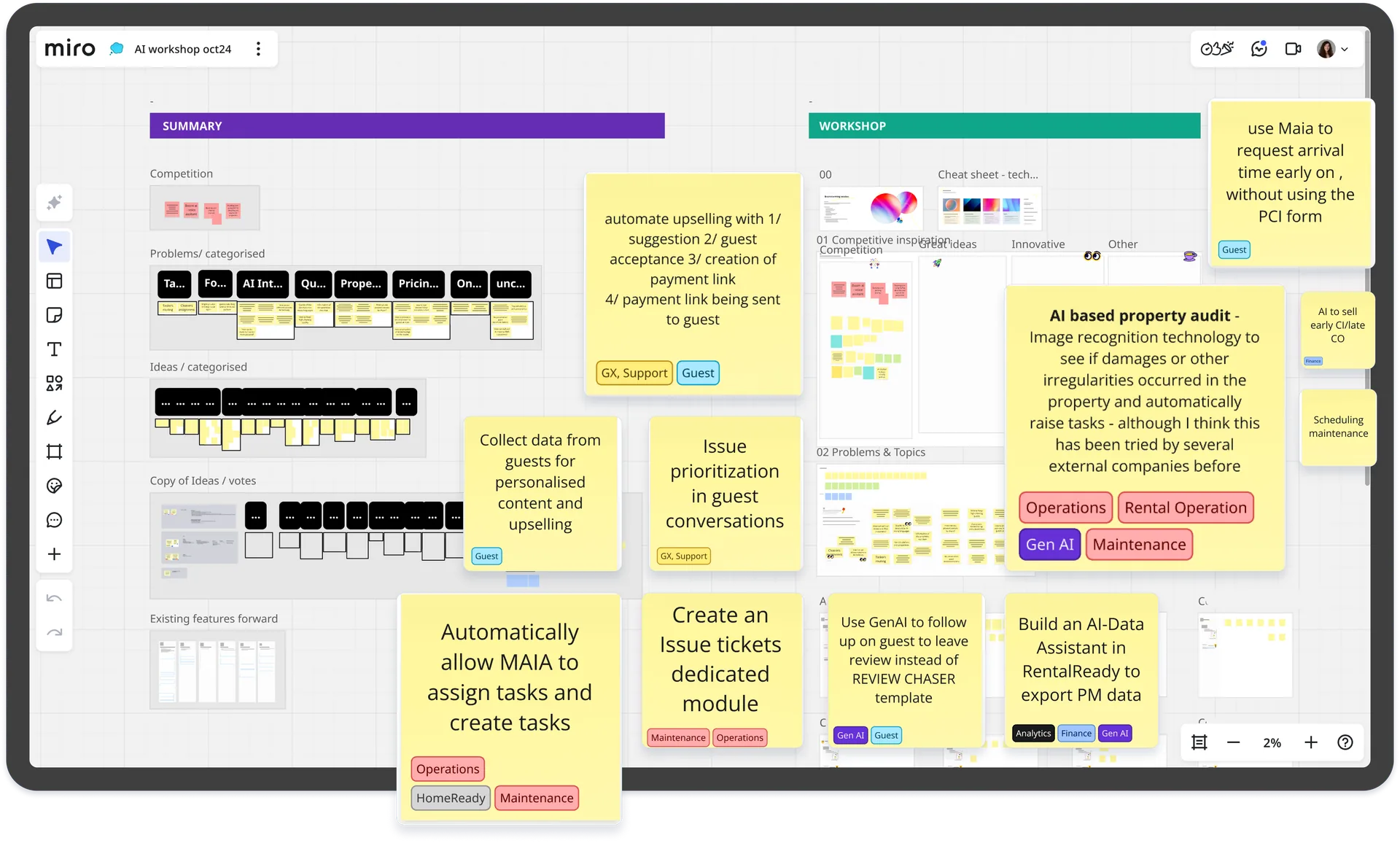
Outcome of workshop, Q3 2024
Today
Maia's ticket creation from conversations
Shipped. Expanded Maia from messaging into operations. 92% of all tickets auto-flagged today
Data assistant
Shipped as Maia Insights: prompt canvas to fetch and analyse data, predict trends, suggest improvements, and perform certain actions in bulk.
Improved existing features
Improved property audit, guest mood, thread summaries, review replies
Train Maia for proactive upselling
Reactive only. Maia handles upsells and extensions when a guest asks. Proactive initiation not prioritised
Guest-facing UI and inbox: AI improvements to predict behaviour and preferences
Not prioritised
Predict customer churn
Not prioritised within the Product team, moved to the Data team
Maia Ticketing: removing friction from Operations
One outcome of the workshop was to keep improving Maia, with a defined opportunity to focus on property quality and general operations. Maia creates tickets from guest conversations and reviews, and delegates them to the right team with clear context and priority.
What customers care about is keeping the quality of their properties high, and thus keeping or growing their own customer base, property owners. Quality of property, service and communication leads to great reviews, and reviews are what new guests decide on, which means higher occupancy and revenue.
"Operations" in property management refers to the daily workflow and tasks that are an inevitable part of the business. Making sure cleaning is done by cleaners, that a checklist tells them what to do, that someone reviews the work and takes care of any reported issues. Cleaners and guests are the people who physically visit the properties, and they are the ones who will tell you when something is wrong and needs maintenance. These operations are handled through HomeReady, the ticketing system inside RentalReady.
Some reservations face multiple problems during the stay, and each one adds another handoff. These average a rating of 3.23*, compared to the 4.7* we aim for, which makes them the largest bad-review-risk segment in the portfolio, and the one that needs immediate attention. This is where Maia helps users prioritise and foresee risk. Users can set up multiple ticketing agents, each with its own instructions and defined scope.
It is more time-efficient for someone on the Operations team to review tickets created by Maia than to track conversations and reviews one by one and open the tickets manually.
Today Maia auto-flags 41,300 of 44,700 tickets, around 92% of everything in the system (Q2 2026). 44% of them are process, setup or inquiry-driven: access, payment, instructions, invoices. The other 56% are real property events that need someone on site to fix.
Today Maia auto-flags 41,300 of 44,700 tickets, around 92% of everything in the system (Q2 2026). 44% of them are process, setup or inquiry-driven: access, payment, instructions, invoices. The other 56% are real property events that need someone on site to fix.
92%
of all tickets auto-flagged by Maia — 41,300 of 44,700 in Q2 2026
44% process, setup or inquiry-driven: access, payment, instructions, invoices
56% real property events that need someone on site to fix
Outcome
The project proved itself in Q2 2026, when Maia's coverage rose from 38% to 54% of reservations in a single quarter and the guest communication rating rose with it, from 4.58* to 4.71* out of 5*. Thanks to Maia, the human response time is now 12 minutes, down from 22 minutes.
Today Maia is one of RentalReady's main selling points. It is enabled for 5,781 properties, 49% of the platform, at a flat rate of €5 per property per month, generating around €350,000 in 2026.
Maia was the first AI agent built directly into a PMS as a feature, not a third-party tool or integration. Two years on, the quality of its answers is significantly ahead of what competitors offer, because it handles complex flows, is customisable, and works on the customer's own data rather than on a generic knowledge base.
What started as three people, a designer, a CTO and a software engineer, became one of the business's strongest commercial assets, and a tool that saves customers real time on guest support. It also earns them money through upselling, stay extensions and inquiry chasing, and it catches problems inside the property by turning what a guest says into a ticket for the team that can fix it.
Ethical AI is not a one-time audit: new models are introduced, regulations change, users adapt, and new needs emerge, which is why monitoring and continuous improvement are essential when designing AI products.
54%
of reservations covered by Maia AI
5,781
properties, 49% of the total
815k
messages sent by Maia to guests in Q2 2026
92%
of all tickets auto-flagged by Maia, 41,300 of 44,700
Today Maia is one of RentalReady's main selling points. It is enabled for 5,781 properties, 49% of the platform, at a flat rate of €5 per property per month, generating around €350,000 in 2026.
Maia was the first AI agent built directly into a PMS as a feature, not a third-party tool or integration. Two years on, the quality of its answers is significantly ahead of what competitors offer, because it handles complex flows, is customisable, and works on the customer's own data rather than on a generic knowledge base.
What started as three people, a designer, a CTO and a software engineer, became one of the business's strongest commercial assets, and a tool that saves customers real time on guest support. It also earns them money through upselling, stay extensions and inquiry chasing, and it catches problems inside the property by turning what a guest says into a ticket for the team that can fix it.
Ethical AI is not a one-time audit: new models are introduced, regulations change, users adapt, and new needs emerge, which is why monitoring and continuous improvement are essential when designing AI products.
How I work
Other projects